
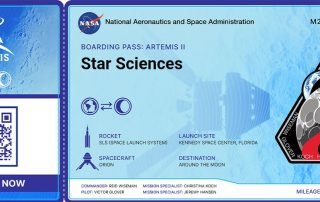
Send Your Name Around the Moon with NASA’s Artemis II Mission
Have you ever dreamed of going to space? What if you could send your name on a real space mission — even if you never put on a spacesuit? NASA’s “Send Your Name with Artemis” campaign gives you that chance. Through this free, global initiative, anyone — students, families, educators, and space enthusiasts around the world — can submit their name to be carried around the Moon aboard the upcoming Artemis II mission. What Is the Artemis Program? The Artemis program is NASA’s ambitious effort to return humans to the Moon and establish a long-term presence there — as
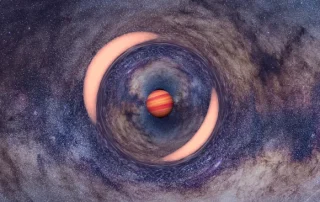
Astronomers detect rare ‘free floating’ exoplanet 10,000 light-years from Earth
Rogue planets — worlds that drift through space alone without a star — largely remain a mystery to scientists. Now, astronomers have for the first time confirmed the existence of one of these starless worlds by pinpointing its distance and mass — a rogue planet roughly the size of Saturn nearly 10,000 light-years from Earth. Planets are typically found bound to one or more stars. However, in 2000, astronomers detected the first signs of a "rogue planet" — a free-floating world that orbited no star. Then, in 2024, researchers detected an object distorting the light from a distant star, simultaneously from both
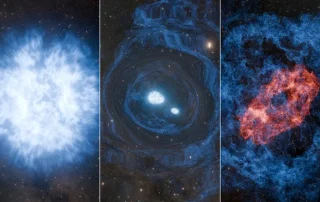
First-ever ‘superkilonova’ double star explosion puzzles astronomers
Scientists may have witnessed a massive, dying star split in two and then crash back together, triggering a never-before-seen double explosion. The explosion sent ripples through space-time and forged some of the universe's heaviest elements. Most massive stars reach the ends of their lives by collapsing and exploding as supernovas, seeding the cosmos with elements such as carbon and iron. A different kind of cataclysm, known as a kilonova, occurs when the ultradense remnants of dead stars, called neutron stars, collide, forging even heavier elements like gold. The newly identified event, named AT2025ulz, appears to combine these two types of
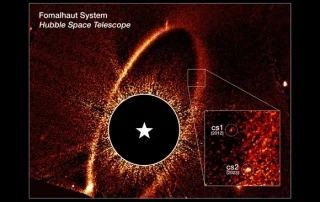
Scientists spot ‘unprecedented celestial event’ around the ‘Eye of Sauron’ star just 25 light-years from Earth
Astronomers hoping to observe a planet around a nearby star have witnessed a much rarer "unprecedented celestial event," the team said: The violent aftermath of not one, but two collisions between the rocky building blocks of planets. Over the past two decades, astronomers witnessed two separate catastrophic collisions around the star Fomalhaut, located just 25 light-years away in the constellation Piscis Austrinus. The detections occurred after planetesimals (rocky pieces of unformed planets) measuring much larger than the dinosaur-killing asteroid smashed each other into massive clouds of glittering debris. Read Article
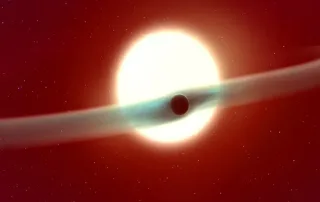
James Webb Space Telescope discovers a hot Jupiter exoplanet leaking twin gas tails that defy explanation
Astronomers have used the James Webb Space Telescope (JWST) to discover that a distant "hot Jupiter" planet has two staggeringly long tails composed of helium that currently defy explanation. The observations represent the first study of gases leaking from a planet beyond the solar system during one of its complete orbits, and help paint the most complete picture of atmospheric escape thus far. The extrasolar planet, or exoplanet, in question is WASP-121b, also known as "Tylos," located around 858 light-years away. WASP-121b is an example of an "ultrahot Jupiter," a massive gas giant planet found so close to its parent star that it
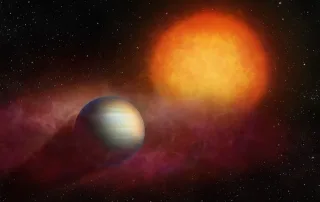
James Webb telescope spots strange ‘super-puff’ planet frantically chasing its own atmosphere through space
New James Webb telescope observations of the 'super-puff' planet WASP-107b show that the exoplanet's runaway atmosphere is frantically escaping into space. A "super-puff" exoplanet is leaking a lot of helium into space, new observations show — and may be in the process of losing a lot of its atmosphere. A large plume of helium gas was spotted evaporating from the giant planet, known as WASP-107b, according to research based on observations from the James Webb Space Telescope (JWST). The results, published Monday (Dec. 1) in the journal Nature Astronomy, show that the gas spanned an area nearly five times