
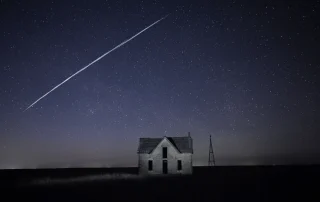
Study shows how earthquake monitors can track space junk through sonic booms
As more and more space junk comes crashing down, a new study shows how earthquake monitors can better track incoming objects by tuning into their sonic booms. Scientists reported Thursday that seismic readings from sonic booms that were generated when a discarded module from a Chinese crew capsule reentered over Southern California in 2024 allowed them to place the object’s path nearly 20 miles (30 kilometers) farther south than radar had predicted from orbit. Using this method to track uncontrolled objects plummeting at supersonic speeds, they said, could help recovery teams reach any surviving pieces more quickly — crucial if the debris is dangerous. Read Article
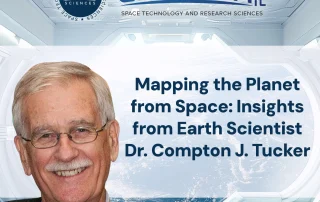
Mapping the Planet from Space: Insights from Earth Scientist Compton Tucker
On the latest episode of Stars Launch Pod: Space, Technology, and Research Sciences, we had the pleasure of speaking with Compton Tucker, an Earth scientist and academic who uses satellite data to study our planet. Tucker’s groundbreaking work combines remote sensing, high-performance computing, and ecological research to better understand trees, glaciers, and global photosynthesis. Using Satellite Data to Study Earth Compton Tucker specializes in analyzing satellite data to monitor global land photosynthesis, track glacier extent, and predict agricultural productivity. He explains, “Some of the datasets we use can also track infectious diseases because of associations with weather and climate.”

Janet Ivey on Wonder, Space, and Inspiring Young Explorers
Explore the magic of STEM education with Janet Ivey, the powerhouse behind Janet’s Planet. Her stories, wisdom, and humor ignite a sense of possibility in learners of all ages. This episode is a joyful reminder that the universe is waiting for you to explore it. Susan Wise: Hi, and welcome to Stars Launch Pod, Space Technology and Research Sciences—brought to you by StarSciences.org, where we connect, collaborate, and accelerate. I'm your host, Susan Wise, and I am thrilled and so excited to have with us on Stars Launch Pod today, Janet Ivey of Janet's Planet. Yay! Janet Ivey,
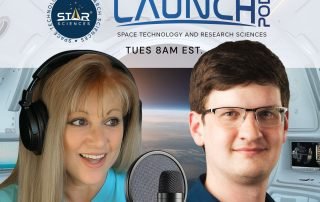
Cleaning Up Space: Adam Kall on In-Orbit Logistics & Innovation
Join host Susan Wise as she chats with Adam Kall, Chief Strategy Officer at Kall Morris Incorporated, about revolutionizing in-space logistics and tackling the growing challenge of orbital debris. Discover how his startup’s octopus-inspired spacecraft could change the future of satellite operations — and open the door to building the next generation of space infrastructure. Susan Wise: Hi, and welcome to Stars Launch Pod, Space Technology and Research Sciences, brought to you by StarSciences.org, where we connect, collaborate, and accelerate. I'm your host, Susan Wise, and joining us is Adam Kall, the Chief Strategy Officer at Kall Morris
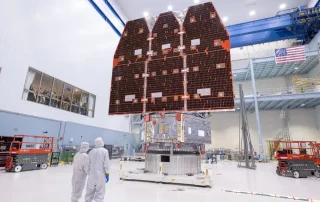
NASA’s powerful new Roman Space Telescope is complete — and will soon begin mission to find 100,000 alien worlds
NASA recently revealed the first pictures of its newly constructed Nancy Grace Roman Space Telescope, which could soon help researchers hunt for exoplanets, map the Milky Way and unravel some of the universe's biggest mysteries, such as the true nature of dark matter. Experts have also revealed the most probable launch date for the next-generation spacecraft, confirming that it will likely lift off ahead of schedule — and could begin collecting data before the end of 2026. Roman is NASA's next flagship space telescope, following on from the Hubble Space Telescope, which launched in 1990, and the James Webb Space Telescope (JWST), which launched in 2021. The orbital
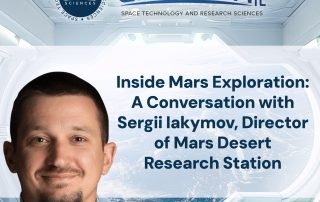
Inside Mars Exploration: A Conversation with Sergii Iakymov, Director of Mars Desert Research Station
The dream of exploring Mars is closer than ever, and we had the incredible opportunity to speak with Sergii Iakymov, aerospace engineer and director of the Mars Desert Research Station (MDRS), on Stars Launch Pod: Space, Technology, and Research Sciences. Here’s a glimpse into his work, the challenges of space analog research, and what it takes to prepare humans for life on Mars. What Is the Mars Desert Research Station? Located in the remote deserts of Utah, the MDRS is a research facility designed to simulate the conditions of Mars. Sergii explains, “We conduct human factor research, geology studies,